Shipping from Korea: Sea Freight, Air Freight and Express Compared
Most goods from Korea travel by sea from Busan: about 11–14 days port-to-port to the US West Coast, and 36–53 days to Rotterdam while Busan's Europe services still sail around Africa. Air freight and express couriers from Incheon take days instead of weeks but cost far more per kilo. The right choice depends on volume, value, urgency and whether your product counts as dangerous goods.
Key takeaways
- Sea freight from Busan takes 11–14 days port-to-port to Long Beach or Los Angeles, about 25 days to New York and 36–53 days to Rotterdam via the Cape of Good Hope (HMM schedules as of July 2026). Door-to-door adds handling and customs time.
- Below roughly 10 CBM, shared-container (LCL) freight is usually cheaper. From about 10–15 CBM, compare it with a full 20-foot container. There is no fixed break-even.
- Freight rates move every week. On 28 September 2026 the KCCI index put Busan to the US West Coast at $8,000 per 40-foot container and Busan to North Europe at $3,751. Always compare dated quotes.
- Since 1 January 2026, lithium-ion batteries packed with equipment must fly at no more than 30% state of charge. Perfume and many aerosols are dangerous goods, and Korea Post EMS does not accept them.
- The US de minimis exemption is suspended, so every parcel needs a customs entry. The EU charges €3 duty per item on parcels up to €150 from 1 July 2026.
- Incoterms 2020 are still current. FCA or FOB usually works better than EXW, because the Korean seller has to file the export declaration.
Which shipping method should you use from Korea?
Choose by volume and urgency first, then by product. Full or shared containers by sea are the cheapest per unit for anything beyond a few cartons. Air freight suits urgent or high-value cargo. Couriers and Korea Post suit samples and small parcels.
| Mode | Typical transit | Best for | Watch out for |
|---|---|---|---|
| Sea, full container (FCL) | 11–14 days Busan to US West Coast, about 25 to New York, 36–53 to Rotterdam (port-to-port) | From roughly 10–15 CBM, and heavy cargo | You pay for the whole container, full or not; late collection at destination adds port and container charges |
| Sea, shared container (LCL) | FCL time plus extra time for consolidation and unpacking | A few CBM up to about 10–15 CBM | Higher cost per CBM than FCL and more handling, so pack and label cartons well |
| Air freight | Typically about 3–7 days door-to-door for standard services, longer for economy | Urgent, high-value or light cargo | Charged on chargeable weight; strict dangerous goods rules for batteries, perfume and aerosols |
| Express courier (DHL, FedEx, UPS) | Priority services quote 1–3 business days, plus customs time | Samples, documents, small urgent orders | Highest cost per kilo; every US-bound parcel now needs a customs entry |
| Korea Post EMS and K-Packet | EMS standard: 3–4 days to North America, 3–5 days to Europe, plus customs | Small parcels: EMS up to 30 kg, K-Packet up to 2 kg | No perfume, aerosol sprays or most devices with lithium batteries |
Transit times for sea are carrier pro-forma schedules, not guarantees. Congestion, skipped sailings and weather change them, and door-to-door delivery adds trucking, terminal handling and customs at both ends.
Which Korean ports and airports do shipments leave from?
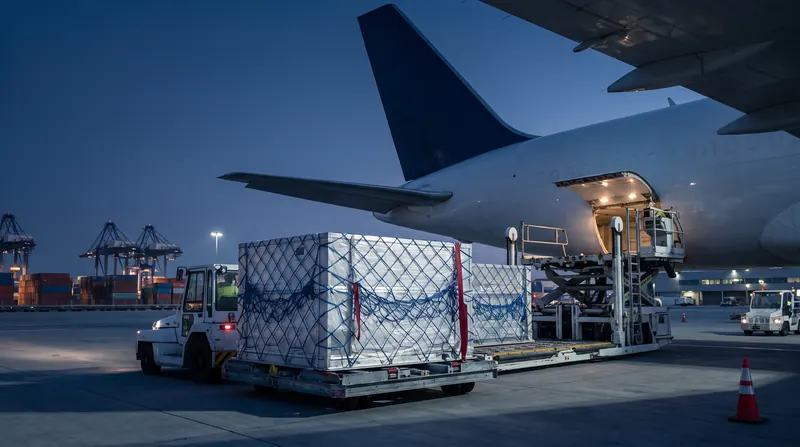
Most long-haul container cargo sails from Busan, and most air cargo flies from Incheon International Airport. Your forwarder picks the gateway, but it helps to know why.
- Port of Busan. Busan handled a record 24.88 million TEU (twenty-foot equivalent units) in 2025, up 2.0%, according to the Busan Port Authority. About 57% of it was transshipment cargo moving between other countries' ports. Lloyd's List ranks it the world's 7th-busiest container port in its 2026 edition.
- Incheon International Airport. It handled 2.95 million tonnes of cargo in 2025, 7th in the world for total cargo in ACI World's ranking. It is the natural gateway for air freight and express parcels.
- Incheon port and other west-coast ports. Incheon is Korea's second-largest container port, next to the Seoul region, and most of its traffic is Korea's own imports and exports. Ask your forwarder whether a sailing from Incheon suits your destination or whether trucking to Busan gives a better service.
FCL or LCL: when is a full container worth it?
Below roughly 10 cubic metres (CBM), shared-container (LCL) freight is usually the cheaper option. Between about 10 and 15 CBM, ask for both quotes. There is no fixed break-even, because destination charges and inland trucking differ by port.
With LCL, your cartons are consolidated with other shippers' cargo at a container freight station (CFS) and priced mainly per CBM. It is more expensive per CBM than a full container (Freightos notes it can be up to twice as much), and it takes a little longer because of consolidation at origin and unpacking at destination. With FCL, you pay per container whatever you load.
| Container | Internal volume | Practical use |
|---|---|---|
| 20-foot standard | About 33 m³ | Heavy goods, or loads from roughly 10–15 CBM upward |
| 40-foot standard | About 67 m³ | Larger orders of general cargo |
| 40-foot high cube | About 76 m³ | Light, bulky goods such as textiles or packaging |
You never fill the full internal volume, because cartons do not stack perfectly. To estimate volume, multiply each carton's length, width and height in metres and add them up. A 60 × 50 × 40 cm carton is 0.12 CBM.
How long does sea freight from Busan take?
Port-to-port, about 11–14 days to the US West Coast, 25–30 days to the US East Coast, 36–53 days to Northern Europe and 24–29 days to Australia. These figures come from HMM's pro-forma schedules as of 1 July 2026; other carriers' services can differ.
| Busan to | Port-to-port days | Note |
|---|---|---|
| Long Beach / Los Angeles | 11–14 | Three HMM services |
| Vancouver | 12 | |
| New York | 25 | |
| Savannah | 28–30 | |
| Houston | 25 | |
| Rotterdam | 36–53 | Via the Cape of Good Hope |
| Felixstowe / Southampton | 48 | Via the Cape of Good Hope |
| Valencia / Genoa | 49 / 56 | Via the Cape of Good Hope |
| Sydney / Melbourne | 24 / 29 | Calls at Chinese ports en route |
| Ho Chi Minh City / Laem Chabang | 6–9 / 8–12 | |
| Jakarta / Manila | 11 / 3 | |
| Nhava Sheva (Mumbai) | 17 |
For a delivery date, add the trip to the port, export clearance, the carrier's cargo cut-off before departure, and customs clearance and delivery at destination. Korean public holidays such as Seollal (Lunar New Year) and Chuseok also slow production and trucking, so plan around them.
How do the Red Sea and Hormuz crises affect shipping from Korea?
Most Busan–Europe cargo still sails around Africa, and conflict in the Middle East has added fuel surcharges. Both can change at short notice, so check the routing and surcharges on every quote.
- Red Sea and Suez. Since Houthi attacks on shipping began in late 2023, most Asia–Europe services have avoided the Red Sea. The return is partial: in September 2026 Maersk moved four more of its Gemini services back to the Suez Canal, conditional on stability in the region. HMM's Busan-calling Europe services were still scheduled via the Cape of Good Hope in its third-quarter 2026 schedule. A Suez routing saves roughly 10 days on Asia–Northwest Europe, according to ING.
- Strait of Hormuz. Shipping through the strait has been severely restricted since the conflict began in late February 2026, and fuel costs have risen. CMA CGM added an emergency fuel surcharge of $150 per TEU on dry head-haul cargo from 1 August 2026, and ONE $75 per TEU from 15 August. Maersk and MSC announced fuel surcharges too. Cargo for Gulf destinations is moving via feeder ships and overland routes at much higher cost, Lloyd's List reports.
How much does container freight from Korea cost in 2026?
Rates change weekly, so treat any index as a reference point and compare dated quotes. The Korea Containerized Freight Index (KCCI) is published every Monday by the Korea Ocean Business Corporation and tracks container rates on 13 routes from Busan.
| Busan to | KCCI, 28 Sep 2026 (US$ per 40-ft container) |
|---|---|
| US West Coast | 8,000 |
| US East Coast | 11,294 |
| North Europe | 3,751 |
| Mediterranean | 4,016 |
| Middle East | 8,627 |
| Australia | 4,885 |
| Southeast Asia | 1,391 |
Drewry's World Container Index of 1 October 2026 shows the same pattern from China: a composite of $4,434 per 40-foot container, $7,835 from Shanghai to Los Angeles and $3,399 from Shanghai to Rotterdam. Drewry noted that Asia–Europe rates had fallen for 12 consecutive weeks on weak demand, while Shanghai–Los Angeles was stable week on week.
Index figures cover the ocean leg only. A real quote adds origin trucking and terminal handling, documents, surcharges, destination charges, customs brokerage, duties and final delivery. Our landed cost guide shows how these add up per unit.
When should you use air freight, express or Korea Post?
Use air freight for urgent or high-value cargo, an express courier for samples and small urgent parcels, and Korea Post for small parcels where a few extra days do not matter.
- Air freight is booked through a forwarder, usually from Incheon. You pay on chargeable weight: the higher of the actual weight and the volumetric weight, which forwarders commonly set at 167 kg per CBM. Light, bulky goods therefore cost more than their weight suggests. Standard consolidated services typically take about 3–7 days door-to-door.
- Express couriers such as DHL, FedEx and UPS collect from the supplier and handle export and import clearance. Their priority services quote 1–3 business days, not counting customs holds or missing paperwork.
- Korea Post EMS takes goods up to 30 kg (less for a few countries), with published delivery standards (set for documents) of 3–4 days to North America and 3–5 days to Europe, before customs time. K-Packet, aimed at online sellers, takes items up to 2 kg.
What changed for small parcels to the US and EU?
Low-value parcels no longer enter the US or the EU duty-free. This matters most for samples, e-commerce orders and direct-to-consumer shipments.
- United States. The $800 de minimis exemption was suspended for all countries on 29 August 2025. In June 2026 CBP made the suspension indefinite: from 24 June for courier and freight shipments and from 24 July for mail. The legal exemption itself is repealed from 1 July 2027. Every parcel now needs a formal or informal customs entry and pays duty; mail up to $2,500 can use a new postal informal entry process. Korea Post ships to the US with the sender prepaying the duty.
- European Union. From 1 July 2026, the €150 duty exemption is replaced by a temporary flat customs duty of €3 per item on parcels worth up to €150, until 1 July 2028. An "item" is each tariff classification in the parcel, not each unit: five T-shirts count as one item, a T-shirt and a watch as two. Korean-origin goods escape it only through a full customs declaration with an FTA preference claim, without VAT collected through IOSS. Import VAT is still due.
US duty rates on Korean goods changed several times in 2025–2026. See our trade agreements guide for the current position, and confirm the rate for your HS code (the product's customs classification number) with a licensed customs broker.
Which products need dangerous goods handling?
Lithium batteries, perfume, alcohol-based cosmetics, nail polish and aerosols are the Korean products most often classed as dangerous goods. Tell your forwarder before booking, because they limit which carriers and modes you can use.
- Lithium-ion batteries by air. Under IATA's 2026 rules, batteries packed with equipment (UN3481) must be shipped at no more than 30% state of charge from 1 January 2026; small cells and batteries of 2.7 Wh or less are excepted. Batteries shipped on their own (UN3480) must also be at no more than 30% and may only travel on cargo aircraft. For batteries inside devices, 30% is recommended but not mandatory. The manufacturer or distributor must make a UN 38.3 test summary available.
- Perfume and flammable cosmetics. Perfume is UN1266, a Class 3 flammable liquid. By air it needs trained packing, approved packaging, hazard labels and a Shipper's Declaration for Dangerous Goods. Korea Post EMS does not accept perfume, aerosol sprays or acetone nail remover.
- By sea. Amendment 42-24 of the IMDG Code, the international rulebook for dangerous goods at sea, has been mandatory since 1 January 2026. The shipper's dangerous goods declaration is a binding legal statement.
Which Incoterm should you use when buying from Korea?
Incoterms 2020 are still the current rules. The International Chamber of Commerce (ICC) only began work on a revision, Incoterms 2030, in 2026, and no new text has been published. For most first-time importers, FCA (at the supplier's site or a Busan terminal) or FOB Busan works best, with your own forwarder booking the main freight.
| Term | What the Korean seller does | Risk passes to you | Keep in mind |
|---|---|---|---|
| EXW (Ex Works) | Makes the goods available at its premises, not loaded and not cleared for export | At the seller's premises | Rarely suitable: a foreign buyer usually cannot file the Korean export declaration |
| FCA (Free Carrier) | Clears the goods for export and hands them to your carrier at a named place | At that place | Fits containers, LCL and air; your carrier can issue an on-board bill of lading to the seller if a letter of credit needs one |
| FOB (Free On Board) | Clears for export and loads the goods on your nominated vessel | Once the goods are on board | Sea freight only |
| CIF / CIP | Also pays the main freight and insurance to the destination | Still at origin | CIF needs only minimum cover (ICC C); CIP requires ICC (A) |
| DAP (Delivered at Place) | Delivers to your named place, ready for unloading | At destination | You still clear import customs and pay duties and taxes |
| DDP (Delivered Duty Paid) | Delivers cleared for import, duties and taxes paid | At destination | Only works if the seller can act as importer or uses an importer-of-record service |
EXW looks simple but causes problems in Korea, because the export declaration has to be filed by a Korea-registered business. Our export procedures guide explains who files it and which documents travel with the goods.
How do you choose the right shipping method? Step by step
- Work back from the date you need the goods. Add production, inspection, export clearance, transit, import clearance and delivery.
- Measure the shipment. Get the carton count, dimensions and gross weight from the supplier's packing list, and work out total CBM and chargeable weight.
- Match the mode. Samples and small parcels go by courier or EMS, urgent or high-value cargo by air, a few CBM by LCL. From about 10–15 CBM, compare LCL with a full container.
- Check the product. Batteries, perfume, aerosols, alcohol and chemicals follow dangerous goods rules. Get the SDS or UN 38.3 summary before you book.
- Check the destination. Look at small-parcel rules, product certificates and whether you need a certificate of origin or origin declaration to claim a lower duty. See our FTA guide.
- Agree the Incoterm and compare dated quotes. Each quote should state the routing, transit time, surcharges and validity date.
How Korea Import Hub helps you ship from Korea
We are a sourcing agent based in Incheon, founded by former Korean exporters. We coordinate freight with forwarders, prepare the export documents and origin paperwork with your supplier, and inspect goods before they ship, with a photo report. If your supplier sells only in Korea, we can buy on your behalf and handle the export. We work in English, Korean, Japanese and Chinese. Tell us about your shipment: the consultation is free, we reply within 24 hours on business days, and you get a written quote before any paid work.
Frequently asked questions
How do I work out CBM and chargeable weight?
Volume in cubic metres (CBM) is length × width × height in metres, so a 60 × 50 × 40 cm carton is 0.12 CBM and 80 such cartons are 9.6 CBM. Shared-container sea freight is priced mainly per CBM. Air freight is charged on chargeable weight: the higher of the actual weight and the volumetric weight, which forwarders commonly calculate as 167 kg per CBM. Couriers use their own volumetric formula, so check their rate card.
Can Korea Post deliver parcels to the United States?
Yes. Korea Post stopped accepting US-bound goods in late August 2025, when the US ended duty-free de minimis treatment. It resumed EMS, international parcels and K-Packet on 22 September 2025, with the sender prepaying US duty through a customs broker. A government data-centre fire stopped acceptance again, and service restarted on 22 October 2025. Fees and rules can change, so check Korea Post's current notices before relying on it.
Do I need cargo insurance if my supplier ships CIF?
Check the level of cover. Under CIF, Incoterms 2020 only require the seller to buy minimum cover (Institute Cargo Clauses C), which covers far fewer risks than all-risks cover. CIP requires the broader ICC (A). Under FOB or FCA the risk is yours from loading or handover in Korea, so arrange your own policy from that point and ask for the insurance certificate with the shipping documents.
What happens if my goods miss the booked vessel?
The forwarder moves them to the next sailing, which on a weekly service means about a week's delay, sometimes with extra storage costs. The export clearance usually stays valid: under Korea's Customs Act, goods must be loaded within 30 days of the export declaration being accepted, and that period can be extended. Agree a cargo-ready date with a safety margin before the carrier's cut-off.
Can I send cosmetics samples by courier or EMS?
Most creams, serums and cleansers ship normally. Perfume (UN1266) is a flammable liquid, and alcohol-based products, nail polish and flammable aerosols can also be dangerous goods that need trained packing, labels and a declaration when flown. Korea Post EMS does not accept perfume or aerosol sprays. Carriers often ask for a safety data sheet (SDS) to confirm a product is not hazardous, so request one from the supplier.
Sources
- HMM Service Network 2026 Q3 (pro-forma schedules as of 1 July 2026) — HMM, July 2026
- Busan Port sets record 24.88 million TEU in 2025 (Korean) — Metro Seoul, reporting Busan Port Authority figures, Feb 2026
- One Hundred Container Ports 2026 — Lloyd's List, 2026
- World's busiest airports: 2025 passenger and cargo rankings — ACI World, July 2026
- World Container Index — Drewry, 1 Oct 2026
- KCCI — Korea Containerized Freight Index (Busan-origin routes) — Korea Ocean Business Corporation, 28 Sep 2026
- Structural changes to AE5, AE11, AE12 and ME2 Gemini services — Maersk, Sep 2026
- Carriers demand new surcharges as Middle East conflict sees bunker costs surge — The Loadstar, July 2026
- Incoterms® 2020 — International Chamber of Commerce
- Lithium Battery Guidance Document (2026 regulations) — IATA, 2026
- Indefinite suspension of the de minimis exemption for merchandise arriving through all modes other than mail — U.S. Customs and Border Protection, Federal Register, June 2026
- Guidance and legal text: temporary flat duty on low-value imports until 1 July 2028 — European Commission, June 2026
Regulations, tariffs and freight conditions change often. This guide is general information, not legal or customs advice — confirm requirements for your product with a licensed customs broker in your country.
Related guides
Korea Export Procedures and Documents, Explained
Who files the export declaration, which documents travel with the goods and how origin proof works.
Read guide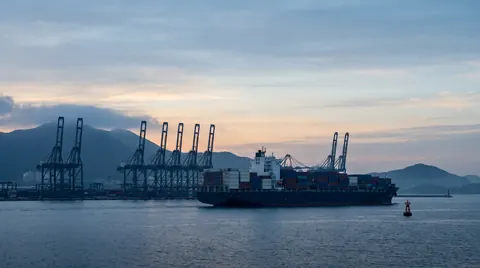
How to Import from Korea: The Complete Guide for 2026
The whole import process in eight steps, with 2026 tariffs, shipping times and a pre-order checklist.
Read guide
How to Find and Verify Reliable Korean Suppliers
Sourcing channels, verification checks and red flags before you pay a deposit.
Read guideNeed help importing from Korea?
We find and verify suppliers, inspect the goods and handle export paperwork and shipping. Free consultation, written quote before any work.